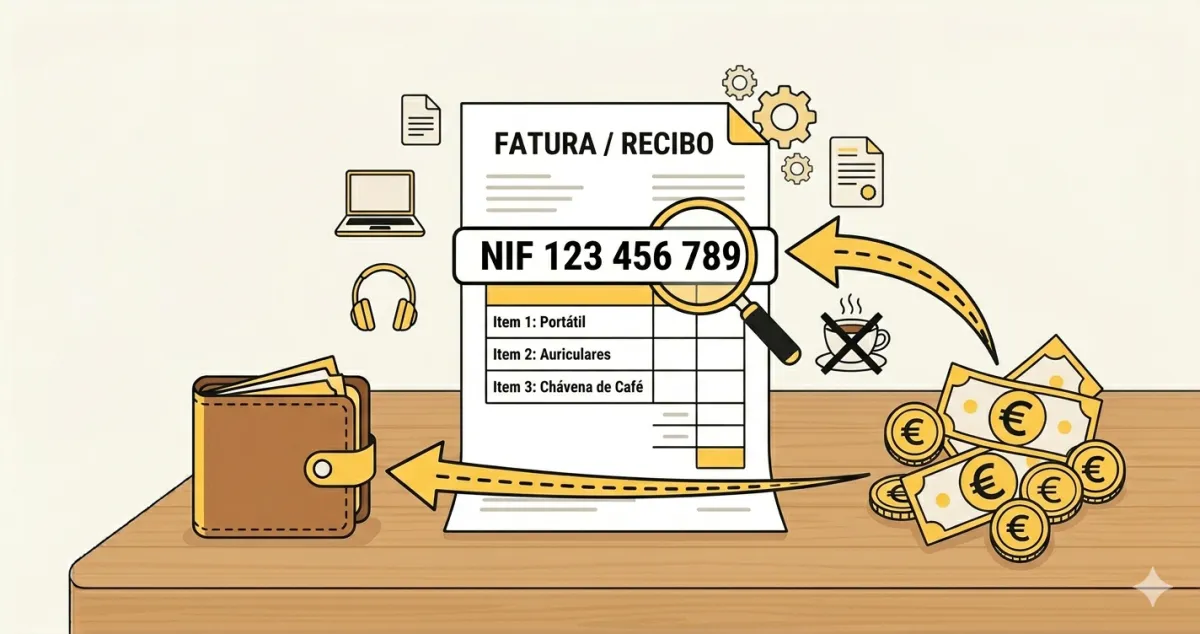

Can a company pay you 1,500 € in banknotes? Can you pay for a 3,200 € laptop in cash? And if you split the amount into two instalments, does it pass?
The answers fit in four numbers - 3,000, 1,000, 10,000 and 500 - all in the same article of the law (article 63.º-E of the General Tax Law, LGT). And the detail almost everyone misses: the limits apply to the person paying and to the person receiving. Taking too much in cash is your infraction too.
The general cap: 3,000 €
It’s forbidden to pay or receive in cash in any transaction of 3,000 € or more - a service, a used car, furniture. It doesn’t matter who you are: private individual, freelancer or company.
Take Sofia, a photographer: a couple wants to pay for their 3,400 € wedding shoot in cash “to keep it simple”. If Sofia accepts, the infraction belongs to both sides - the couple who pays and her who receives. From 3,000 € up, the payment must go through a traceable method: bank transfer, MB Way, cheque.
The rule that catches companies: 1,000 €
For companies (and self-employed workers with organised accounting), the limit is much lower: invoices of 1,000 € or more must be paid by bank means - transfer, nominative cheque or direct debit. Cash is off the table.
That’s the answer to the classic question: “can my client’s Lda pay me in banknotes?” Up to 999.99 €, it can. From 1,000 €, it can’t - and if you accept, you’re taking part in its infraction. Ask for a transfer and you’re both covered.
In the other direction: as a freelancer on the simplified regime (no organised accounting), when you’re the one paying expenses you’re not bound by this 1,000 € rule - only by the general 3,000 € cap. What matters for the 1,000 € rule is always who pays, not who receives.
The trick that doesn’t work: splitting into instalments
“So we’ll pay the 4,000 € in two payments of 2,000 €.” No: the law aggregates all the payments of the same sale or service. Rui, a carpenter, built a 4,000 € kitchen and accepted two cash instalments of 2,000 € - in the tax authority’s eyes, that was a single 4,000 € cash transaction, over the cap. The maths is done per job, not per handover.
The other two numbers
The 10,000 € one explains why the shop takes the tourist’s hefty cash payment. The 500 € one rarely touches you - VAT, IRS and Social Security payment slips are paid by Multibanco or direct debit anyway.
Warning: cash remains perfectly legal below the limits - the mistake lives elsewhere. Receiving cash without issuing an invoice is what turns a legal payment into undeclared income, a risk that isn’t worth it. The practical rule: paid in banknotes, invoice issued on the spot, and the amount enters your books like any other.
In summary
-
3,000 € is the ceiling for everyone - paying or receiving in cash from there up is an infraction on both sides, and splitting into instalments doesn’t help: payments for the same job count together.
-
With companies, the practical limit is 1,000 €: invoices at or above it are paid by bank means. If your company client insists on banknotes for a 1,000 €+ invoice, the answer is a transfer.
-
Legal cash is invoiced cash. Below the limits, accept it freely - any payment method works - as long as the invoice goes out on the spot. With FIZ you issue it on your phone in seconds, right next to the client, and the quarterly VAT and Social Security declarations follow on their own.