Gonçalo is a UX designer in Lisbon. Last year he billed around €48,000 to clients and paid a substantial amount in VAT each quarter. It was only when an accountant friend asked him “are you deducting the VAT on your expenses?” that he realised he had been losing money every quarter.
“I didn’t know that was a thing,” he admitted. “I assumed the VAT I paid on purchases was just my cost to bear.”
It isn’t. If you charge VAT to your clients, the VAT you pay on professional expenses reduces what you hand over to the state. The mechanism is called input VAT deduction — and many freelancers are completely unaware of it.
Who Can Use Input VAT Deduction
First, an important qualification: this only applies if you are registered for VAT — meaning you invoice more than €15,000 per year and charge VAT on your invoices.
If you invoice below €15,000/year, you are VAT-exempt under Article 53 of the CIVA. That means you don’t charge VAT to clients — but you also cannot deduct the VAT you pay on expenses. It is a trade-off.
Once you cross that threshold and begin charging VAT, you automatically enter this offsetting system: the VAT you collect from clients (output VAT) is reduced by the VAT you paid on your professional expenses (input VAT). The difference is what you remit to the state.
How It Works in Practice — a Quarterly Example
That is €400 per quarter — €1,600 per year — staying in your pocket instead of going to the state. Simply because you asked for an invoice with your NIF.
Your NIF is the Key to Everything
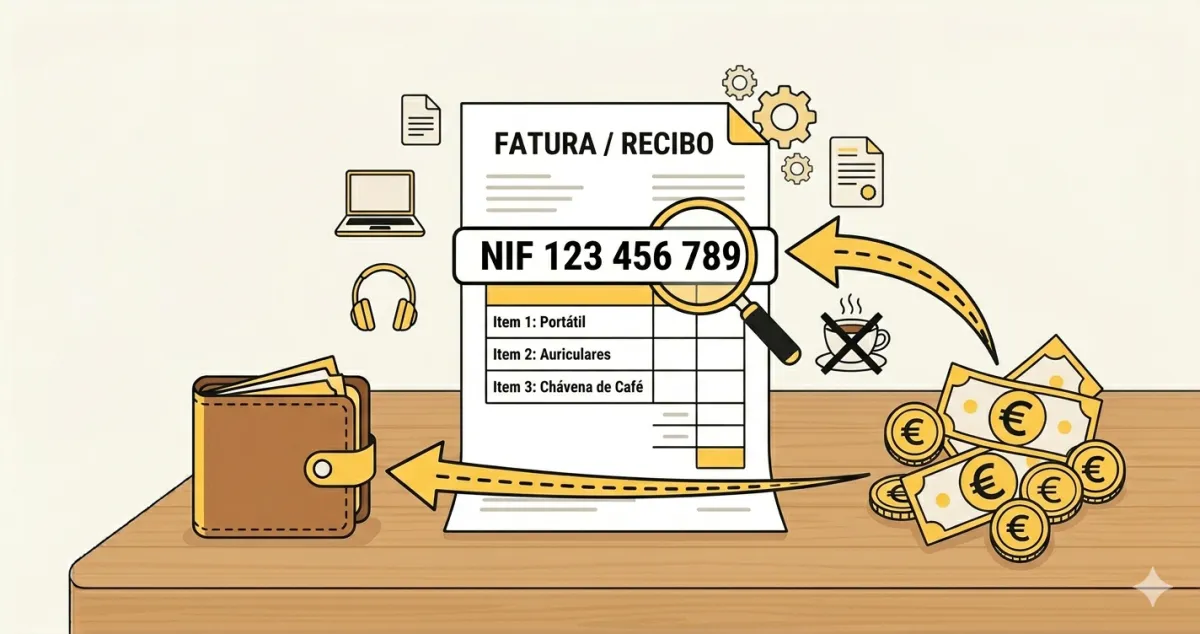
This is the single most important point, and the most common mistake: the invoice must include your Portuguese tax number (NIF). Without it, you cannot deduct the VAT. Full stop.
Mariana, an HR consultant in Porto, bought a new monitor for her home office — €400. At the shop, she did not ask for an invoice with her NIF; she just took a receipt. She lost €92 of VAT deduction on that one purchase. “Lesson learnt. Now I always give my NIF, even for small purchases.”
The habit to build is simple: before paying for anything professional, state your NIF. In a physical shop, tell the cashier. In an online purchase, enter it in the billing field. It takes three seconds and can save hundreds of euros per year.
What You Can Deduct
Expenses must be related to your professional activity:
There are important exceptions: passenger vehicles are very restricted (often 0% deductible), and fuel for passenger cars is generally not deductible. Personal expenses — food, clothing, a mixed-use mobile phone — are also not deductible.
The practical rule: if you can justify an expense to a tax inspector with ease, it is probably deductible. If you would struggle to make the case, leave it out.
How to Declare Your Input VAT
The deduction happens in the periodic VAT return you file quarterly. In the deductions section, you enter the total VAT from your professional expense invoices for that quarter. The system calculates the balance automatically.
This requires you to have kept all the invoices. That is why organisation matters: no invoice, no deduction.
After understanding the mechanism, Gonçalo started filing expense invoices in a digital folder organised by quarter. “It is literally five minutes of work per month. And when the quarter ends, I know exactly how much I’ll be deducting.”
How Much Can You Save
It depends on your volume of professional spending. As a conservative estimate, for someone with €5,000 per year in professional purchases subject to 23% VAT, the deduction reaches €1,150 annually. That is €1,150 that, without this knowledge, would go straight to the state.
Input VAT deduction is not a special tax perk — it is a built-in mechanism designed specifically to prevent double taxation. You pay VAT as a consumer and then collect VAT as a service provider. The deduction balances that equation.
✅ In Summary
- If you charge VAT (billing >€15,000/year), you can deduct the VAT paid on professional expenses — software, coworking, equipment, professional services — reducing what you pay to the state each quarter
- The invoice must include your NIF — without it, no deduction is possible; always give your NIF when buying anything professional, even a small purchase
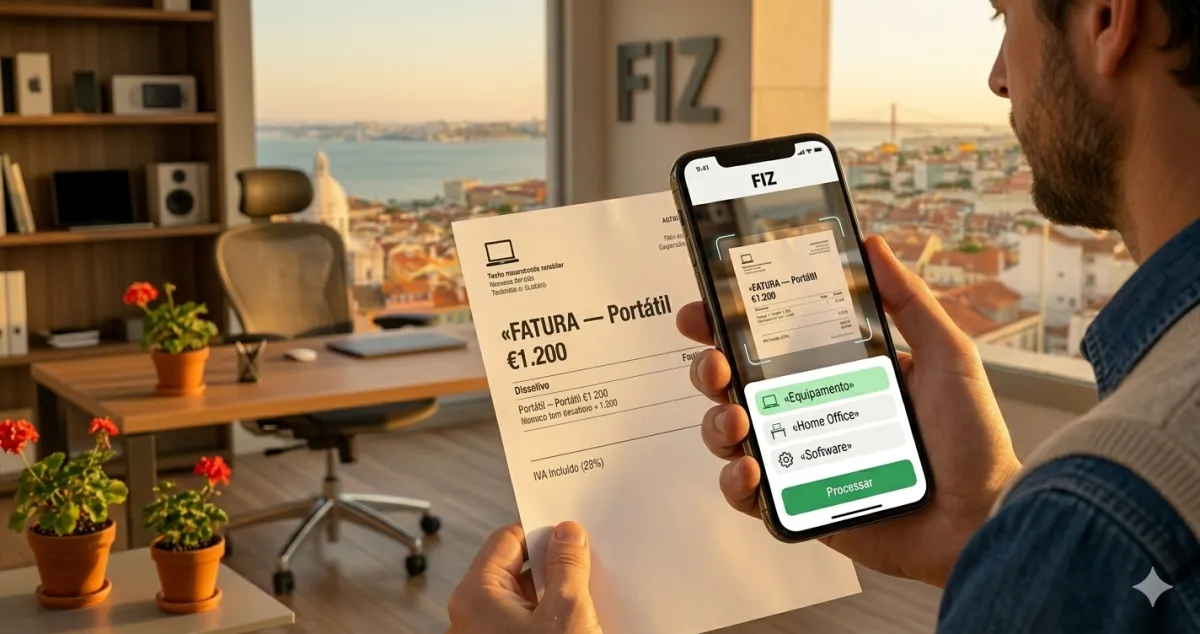
- With FIZ the deductible VAT is calculated automatically from your registered expenses each quarter, so you never miss a deduction you’re entitled to