
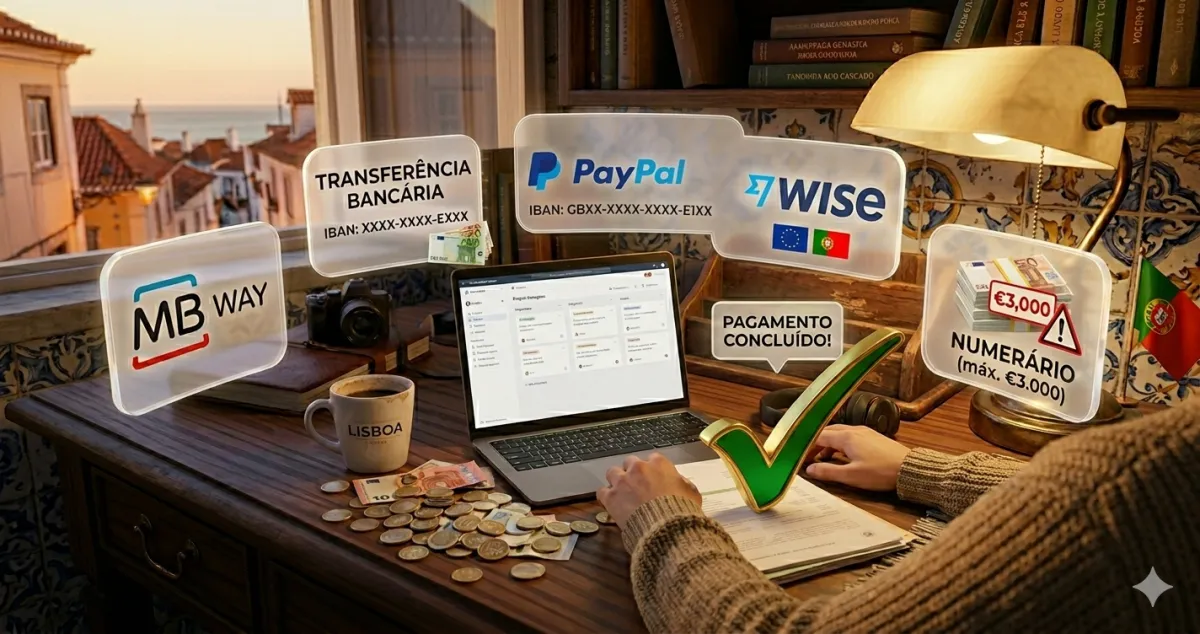
A client wants to pay by PayPal. Another prefers MB Way. A third only has cash. And you’re wondering: “Is all of that legal?”
Yes. You can accept any of these methods. What you can never skip — regardless of how you’re paid — is issuing an invoice.
Bank transfer — the classic
The most common method in Portugal for services to companies. The client asks for your IBAN, makes the transfer, and the money arrives within 1-2 business days (or the same day if from the same bank).
How it works:
- Issue the invoice in FIZ (or other certified software)
- Send by email or WhatsApp with the IBAN included
- The client transfers
- You confirm receipt
Clean, traceable, no fees. Ideal for larger projects and business clients.
MB Way — for quick payments
It revolutionised payments in Portugal. It’s instant, free, and practically everyone has it. Perfect for amounts up to €2,500 (daily limit for most banks).
You finish the job, issue the invoice on your phone, and the client pays right there via MB Way. Within seconds the money is available.
PayPal and Wise — for international clients
If you work with foreign clients, these platforms are essential. Both are completely legal in Portugal.
- PayPal: fees of around 3–4% per transaction
- Wise: lower fees (~0.5–1%), more favourable exchange rates
Important for declarations: you declare the total invoiced amount — not the net amount after fees. If you invoiced €1,000 and PayPal retained €35, you still declare €1,000.
If you provided services to EU companies, those transactions go into the recapitulative declaration. FIZ detects this automatically when you create the invoice with the client’s European VAT number.
Cash — still legal
It surprises many people, but receiving payment in cash is completely legal. The legal limit is €3,000 per transaction (article 63.º-E of the General Tax Law). Above this amount, the law prohibits cash payments - and when the payer is a company, the practical limit drops to €1,000: the full limits are here.
Rules:
- Always issue an invoice (at the time of payment or within 5 days)
- Maximum €3,000 per job or service
- Deposit regularly at the bank
The golden rule: the method changes nothing
Whatever the payment method — bank transfer, MB Way, PayPal, Wise, cheque, cash — the obligation to issue an invoice is always the same. And the tax treatment is identical: if you invoiced €1,000, you declare €1,000.
The payment method never cancels the invoicing obligation.
The most serious mistakes freelancers make:
- Not issuing an invoice because “the client doesn’t want one”
- Assuming PayPal or Wise payments “aren’t traceable” — they are
- Receiving cash without depositing or recording it
⚠️ The tax authority has access to international transfers through information-sharing agreements between countries. Always declaring is the only safe option.
How FIZ records everything
In FIZ, the process is the same regardless of payment method:
- You create the invoice (client, service, amount, VAT)
- You send it to the client by email or WhatsApp
- You mark it as paid when you receive payment
- FIZ records it in the bookkeeping and aggregates it in the dashboard totals
The quarterly declarations — VAT and Social Security — are calculated from these totals and, with the Auto plan, are submitted automatically.
✅ In summary
-
All methods are legal — bank transfer, MB Way, PayPal, Wise, cash (up to €3,000 per transaction). There’s no “preferred” method for the tax authority — what matters is the invoice.
-
The payment method doesn’t change the tax treatment — you always declare the total invoiced amount, regardless of fees or payment form.
-
With FIZ everything is recorded automatically — you create the invoice, receive the payment, and the system aggregates it in your bookkeeping and quarterly declarations. Zero extra admin.