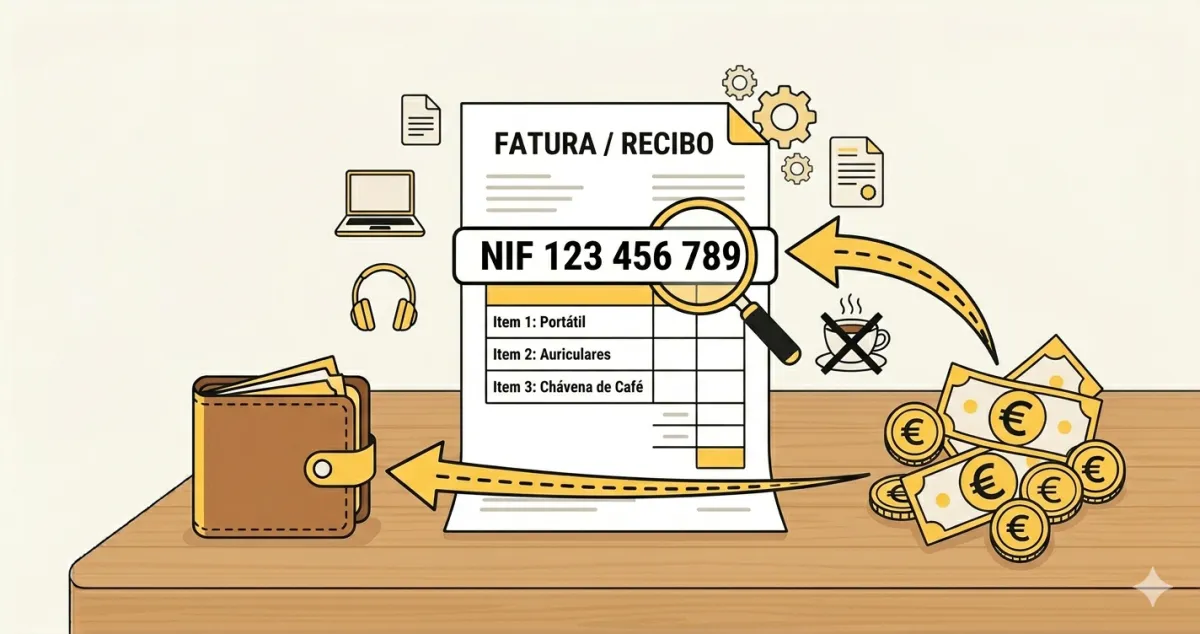

Let’s talk about an uncomfortable truth: you have a master’s degree, speak three languages, master complex technologies… but when someone says “quarterly VAT declaration,” your brain goes into panic mode.
You’re not alone. And more importantly: it’s not your fault.
The Education System Failed You
Think about it: you spent 12 years in school. You learned to calculate the volume of a cylinder, the molecular structure of water, the tributaries of the Tagus River. But nobody taught you how to issue an invoice. Nobody explained what VAT is. Nobody told you that, as an independent worker, you have to submit declarations every 3 months.
The Portuguese school system prepares you to be an employee. Not to work for yourself.
And then they’re surprised you’re afraid.
The Fear Has a Real Origin
When you start working as an independent in Portugal, you discover that:
- You have to submit a quarterly VAT declaration (every 3 months)
- You have to submit a quarterly Social Security declaration (also every 3 months)
- If you provide services to European companies, you have to submit a quarterly Recapitulative declaration
- And of course, the annual income tax return (once a year)
Each declaration has a different deadline. Each has specific rules. And if you make a mistake? The fines can be significant.
Pedro, a 28-year-old graphic designer, says: “In the first year, I didn’t even know I had to submit quarterly declarations. I thought everything was done in the annual income tax return. When I found out, I already had fines to pay.”
The 5 Most Common Fears (And Why They Make Sense)
1. Fear of Making Mistakes on Declarations
Ana works as a digital marketing consultant. She invoices about 2,000 euros per month. “Every time I have to fill in a declaration, I spend hours checking everything. And even then I feel like something’s wrong.”
This fear is rational. An error on a declaration can result in fines. And worse: often you only discover the error months later, when the fine already has interest.
2. Fear of Not Understanding the Calculations
Under the simplified regime (where most independents are), when you provide services, 75% of what you invoice is considered profit for tax purposes. The other 25% is assumed to be expenses.
Example: if you invoiced 10,000 euros in the year, you pay tax on 7,500 euros (not the full 10,000 euros).
Sounds simple? Now add VAT, withholding taxes, advance payments… The complexity adds up quickly.
3. Fear of Fines
João, a freelance programmer, shares: “My biggest nightmare is receiving a letter from the Tax Authority. Even when everything’s correct, I get anxious.”
And he has reason to be anxious. Fines for late declarations can be heavy. And worst of all: they accumulate. If you forget a quarterly declaration, before you know it, that’s 3 months of fines.
4. Fear of Missing Deadlines
Quarterly VAT declaration: by the 20th of the month following the quarter. Quarterly Social Security declaration: during the month following the quarter (January, April, July or October). VAT payment: by the 25th. Social Security payment: by the 20th.
That’s too many dates to keep in your head. Especially when you’re focused on… working and earning money.
5. Fear of Paying Too Much (Or Too Little)
Sofia, a freelance translator, puts it well: “I never know if I’m paying what I should. What if I’m paying too much? What if I’m paying too little and will have problems?”
This fear paralyzes. Many independents end up paying more than they should, just to “be safe.” Others risk it and pay less, living with constant anxiety.
The Most Common Mistake
The most common mistake? Thinking that under the simplified regime “the State takes care of everything.”
This is completely false.
The simplified regime only simplifies the profit calculation (those 75% we talked about). You still have to submit all declarations. The State does nothing for you. If you don’t submit the quarterly declarations, you’ll get fines. Guaranteed.
Fear Is a Sign of Intelligence
Here’s the plot twist: if you fear accounting, it’s because you’re smart enough to understand the consequences of making mistakes.
People who aren’t afraid are usually those who:
- Haven’t yet understood the responsibility
- Have never had a problem with the Tax Authority
- Have someone else handling everything for them
You’re afraid because you understand this is serious. And that makes you a better professional.
How the Best Independents Deal with Fear
Successful independents aren’t the ones who lost their fear. They’re the ones who found ways to manage it.
Marta, a copywriter with 5 years of experience, explains: “In the beginning, the fear paralyzed me. Now I use FIZ - the quarterly VAT and Social Security declarations are submitted automatically. I don’t even think about it.”
Miguel, an IT consultant, adds: “What gave me the most anxiety was the fines. With FIZ’s Tax Shield, if there’s any error on a declaration, they cover the fine up to 500 euros. I sleep peacefully.”
The Truth Nobody Tells You
Traditional accountants thrive on your fear. The more complicated it seems, the more dependent you become on their services.
But the truth is that, for most independents, accounting can be simple. Especially with the right tools.
FIZ, for example, transforms the whole process:
- Issue invoices with 4 simple fields
- Quarterly declarations? Automatic
- Bookkeeping? Records everything automatically
- Questions? The AI Tax Assistant responds within 2 hours
We’re not in 1990 anymore. The technology exists to simplify your life.
In summary:
- Fear of accounting is normal and rational - the education system never prepared you for this, and the consequences of making mistakes are real. You’re not dumb - the system is complex.
- Fear is a sign of seriousness - those who are afraid are the ones who understand the responsibility. These are exactly the people who become the best independent professionals.
- Solutions exist that eliminate the fear - with FIZ, declarations are automatic, you have protection against fines, and you can focus on what really matters: your work.