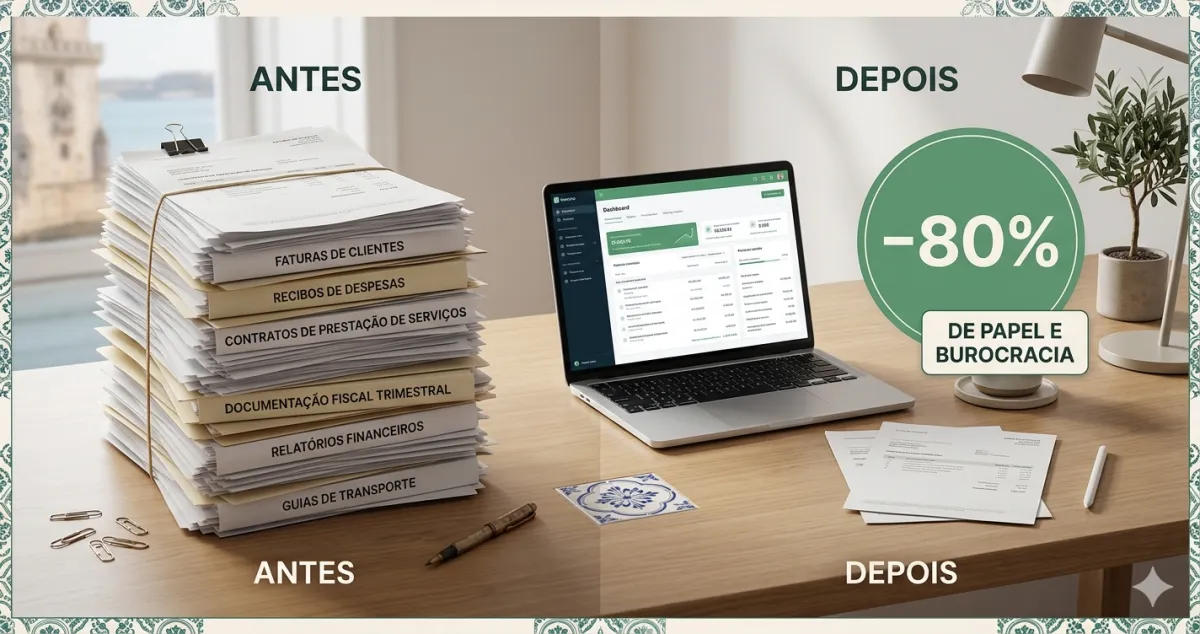
Tiago registered as a freelancer in 2010. He remembers it clearly: he went to a stationery shop to buy a triplicate receipt book, organised a folder for original receipts, built an Excel spreadsheet to track income manually. Every receipt was filled in by hand, with carbon paper in the middle for the copy. If a client asked for a duplicate? Tiago was stuck.
Today, Tiago has a nephew, Diogo, who registered as a freelancer at 24. Diogo has never seen a paper receipt book. The first invoice he issued was from his phone, in two minutes, with a QR code included. The client received the PDF by email before Diogo had finished his coffee.
What happened in these 16 years is one of the most silent — and most useful — transformations in the lives of independent workers in Portugal.
2010: Bureaucracy as a barrier to entry
In 2010, going freelance required considerable administrative stamina. The mandatory steps included:
- In-person registration at the Tax Authority
- A paper receipt book authenticated by the AT
- Physical archiving of all invoices and expenses for 10 years
- Manual VAT calculation and submission on paper forms (or, later, PDFs sent by email)
- Periodic visits to the accountant’s office to “close the quarter”
The fear of getting a number wrong on a form was real. One misplaced decimal and you risked a fine. Most people who wanted to work independently hesitated — not from lack of clients, but from fear of paperwork.
2026: The system works with you
The reality has changed structurally. Three innovations changed everything:
e-Fatura. When you issue an invoice through AT-certified software, it is automatically registered in the Tax Authority’s systems. There is nothing to send, no form to fill in. The communication happens in real time, in the background, without any action on your part.
ATCUD and QR code. Since 2023, all invoices must include an ATCUD (unique identifier) and an automatically generated QR code. Certified software handles this without you needing to understand what it is — just as you don’t need to know how the chip in your bank card works to pay at the supermarket.
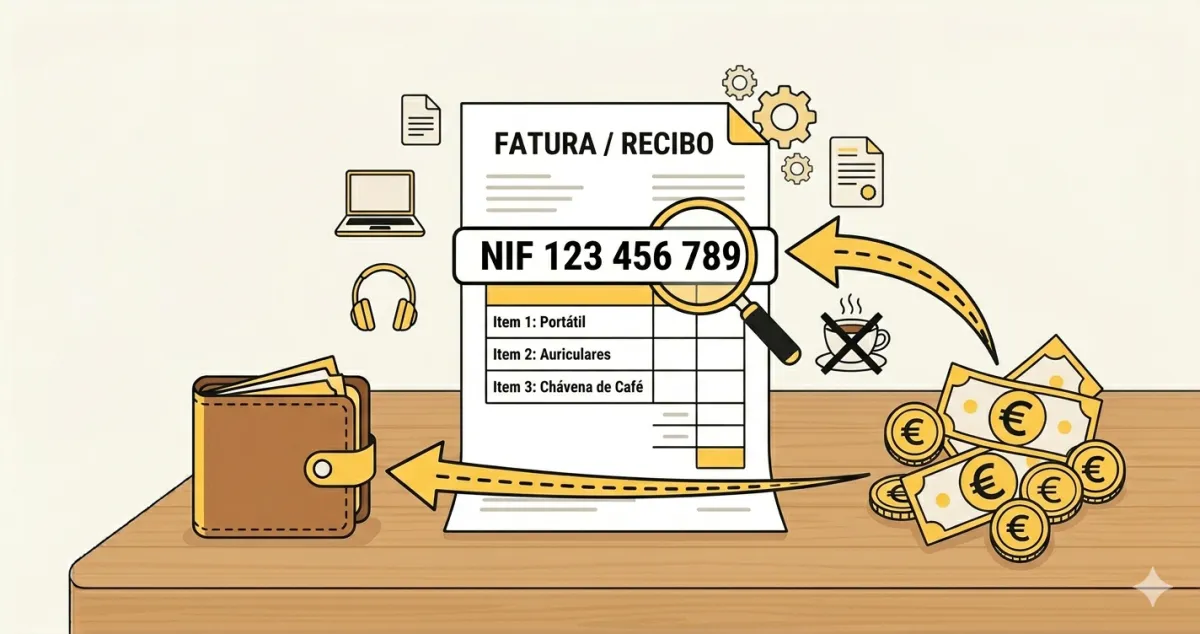
The simplified regime with little paperwork. For the professional activities in the art. 151.º table (designers, programmers, consultants, translators…), the state applies a coefficient of 0.75 (other services use 0.35 — see which coefficient is yours): 75% of what you invoice is considered taxable income, and the remaining 25% is treated as expenses. One nuance worth knowing: 10 points of that reduction are automatic, but the other 15% must be justified (art. 31.º n.º 13 of the CIRS). The good news is that the higher of two amounts counts automatically: the standard deduction (around €4,587 in 2026) or, if larger, the part of your Social Security contributions up to 10% of gross income (anything above those 10% is deducted directly from your income under n.º 2) — in practice, with income up to around €30,000/year you don’t need to do anything; above that, ask for invoices with your NIF and classify business expenses in e-Fatura, or the difference is added back to your taxable income.
The declarations you still need to file — but that no longer consume your day
There is an important point many people confuse: the simplified regime does not mean the state files declarations on your behalf. “Simplified” refers only to how income is calculated (coefficients instead of real expenses). The filing obligations remain yours.
There are three moments you need to manage throughout the year:
- Quarterly VAT: by the 20th of the second month after each quarter ends — Q2 extends to 20 September (those exempt under art. 53.º don’t file the regular return)
- Quarterly Social Security: during the month following the end of the quarter (by the last day of January, April, July and October)
- Annual IRS: once a year, between April and June
The difference compared to 2010? Back then, completing each declaration was a lengthy process with complex forms. Today, with certified software, many platforms submit these declarations automatically — you receive a confirmation on your phone once it is done.
What Diogo does in a typical month
Diogo is a UX designer. He invoices an average of €2,800 a month to three or four clients. His tax routine fits into a short list.
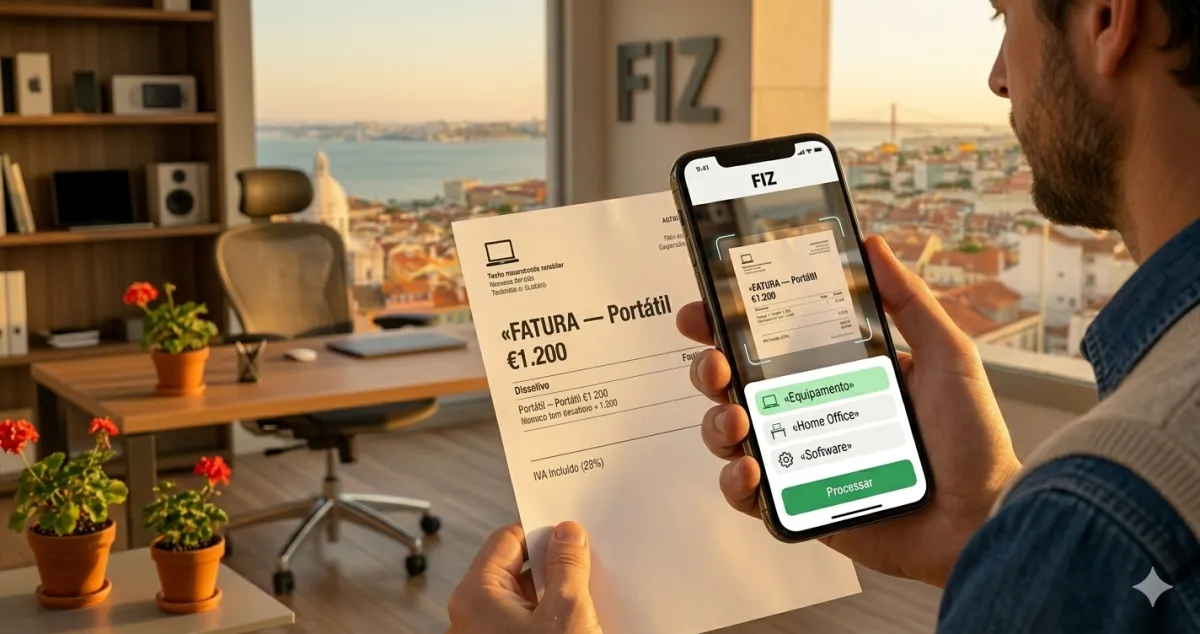
When he finishes a project, he opens the app, fills in four fields (client name, tax number, description, amount) and taps “Issue”. The PDF goes to the client’s email and is registered with the AT at the same time. There is no second step.
At the end of the quarter, the platform he uses automatically submits the VAT and Social Security declarations. Diogo receives a notification: “Declarations submitted successfully.”
In April, he fills in his IRS return using data that is already pre-loaded in the Finance Portal — because all the year’s invoices were communicated automatically throughout the months.
Total time spent on tax administration: fewer than 20 minutes a month.
The fear inherited from another era
When Inês, a wedding photographer, told her mother she was going to register as a freelancer, the response was immediate: “Are you sure? The paperwork is a nightmare.” Her mother was speaking from experience — she had been on the green receipts system in the 1990s and 2000s, when it really was that bad.
What Inês’s mother didn’t know is that most of that paperwork has disappeared. The system today is built to communicate automatically with the Tax Authority. The most common mistakes of the past — forgetting to report an invoice, losing a physical receipt, miscalculating VAT — are no longer possible when the software handles those steps for you.
The fear many people have about freelancer accounting is a fear inherited from a reality that no longer exists. The barrier to entry has dropped dramatically. What required an accountant and an archive folder in 2010 is resolved today with an app and ten minutes.
✅ Summary — 3 key points
✅ Portugal’s tax system is digitally integrated: e-Fatura communicates all your invoices to the AT automatically, ATCUD and QR codes are generated by the software without any input from you, and on the simplified regime expense paperwork comes down to asking for invoices with your NIF and classifying them in e-Fatura (and with income up to around €30,000/year, not even that).
✅ You still have three filing obligations — quarterly VAT, quarterly Social Security, and annual IRS — but with certified software, the first two can be submitted automatically without you opening a single form.
✅ The fear of tax paperwork is a relic of 2010: the reality has changed, technology has absorbed most of the manual work, and what remains is perfectly manageable with the right tools — like FIZ.