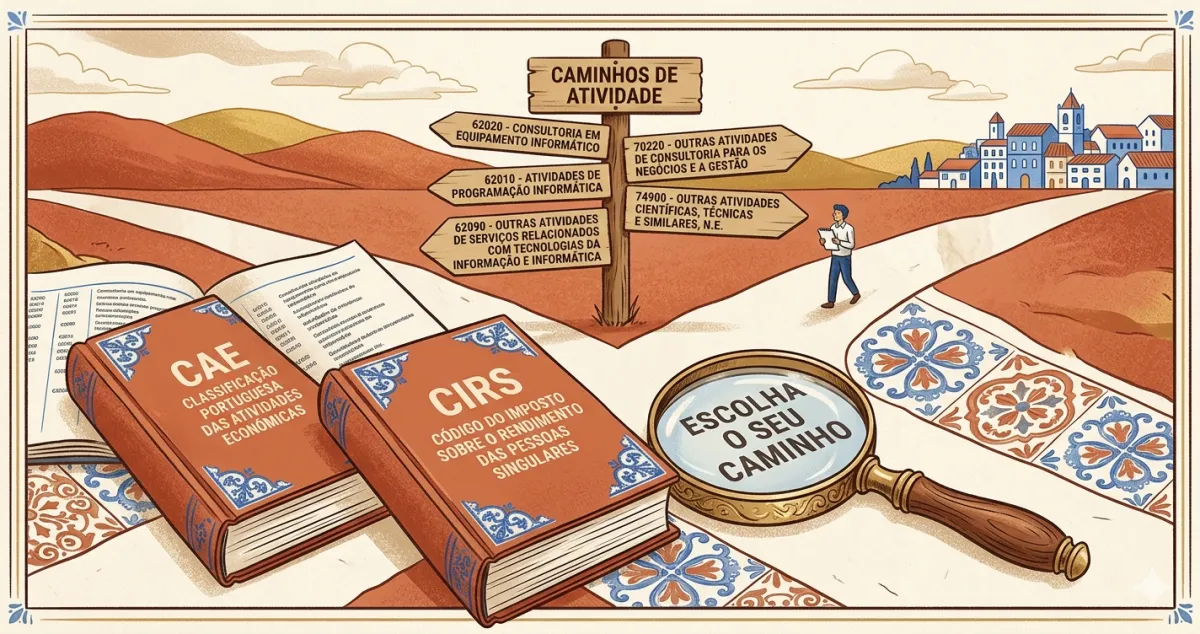
Most people opening their freelance activity for the first time hit a moment of panic when the form asks for their CAE. What is that? Do you need to know it by heart? What if you pick the wrong one?
It is not complicated. And there are no penalties for choosing a code that is not perfectly matched to your work.
What the CAE is
CAE stands for Classificação Portuguesa das Atividades Económicas — Portugal’s economic activity classification. It is a five-digit code that tells the tax authority what you do professionally: design, programming, translation, consulting, photography.
Think of it as the “professional category” in the tax system. It does not define what you are allowed to do — it defines only how you are classified.
The CAE code by profession: lawyers, designers, musicians and more
The table brings together the two codes you will need: the CAE and, where it exists, the code from the Article 151 CIRS table (we explain the difference right below).
| Profession / Activity | CAE | Article 151 code |
|---|---|---|
| Lawyers | 69101 | 6010 |
| Designers (graphic and web) | 74120 | 1336 |
| Programmers | 62100 | 1332 |
| Musicians | 90200 | 2013 |
| Nurses / nursing | 86940 | 5010 |
| Physiotherapists | 86950 | 5012 |
| Teachers | 85593 | 8012 |
| Private tutors | 85593 | 8010 |
| Trainers | 85591 | 8011 |
| Engineers | 71120 | 1003 |
| Architects | 71110 | 1001 |
| Psychologists | 86930 | 1010 |
| Doctors (general practice) | 86210 | 7014 |
| Dentists | 86230 | 7015 |
| Accountants | 69201 | 4013 |
| Business consultants | 70200 | 1320 |
| Advertising and marketing | 73110 | 1333 |
| Photographers | 74200 | — |
| Translators and interpreters | 74300 | 1334 |
| Literary creation & musical composition | 90110 | — see CodeFinder (e.g. 2013 for music) |
| Video production | 59110 | — |
| IT consulting | 62201 | 1313 (systems analysts) |
| Beauticians, manicurists & pedicurists | 96220 | 1325 |
”—” means the profession does not appear as such on the Article 151 table — in that case, look for the closest designation in the finder below, or use code 1519 (other service providers), with the 0.35 coefficient.
One case to keep in mind: massage therapists (massagistas) have their own Article 151 code (1329, 0.75 coefficient), but there is no CAE subclass literally called “massage” — and the right code depends on the type of massage. Therapeutic/clinical massage sits in the health branch (CAE 86950 “Atividades de fisioterapia”, whose scope, per the INE explanatory notes, covers physiotherapy and related techniques such as therapeutic massage and occupational therapy); wellness/relaxation massage fits personal-care wellbeing services (group 96). Confirm on the Portal which subclass best describes what you do.
If you do more than one thing, you choose a primary CAE and can add secondary ones later — see how to hold multiple CAE codes simultaneously.
CAE vs CIRS: what is the difference?
Here is the most common confusion — and the reason so many people search for “CAE code designers” or “CAE code lawyers”. They are actually two different codes:
| CAE | Article 151 code (CIRS) | |
|---|---|---|
| What it is | Economic activity classification | Your liberal profession, for IRS purposes |
| How many digits | 5 (e.g. 74120) | 4 (e.g. 1336) |
| What it determines | How you are classified statistically | Your IRS coefficient (0.75 or 0.35) |
CIRS is the Código do IRS — the law that governs income tax. What you choose is not “the CIRS” itself, but the profession code within the table annexed to Article 151, when that table applies to your activity.
The Article 151 codes for liberal professions
If your profession appears in the Article 151 table of the CIRS, you enter its code when registering your activity. Type your profession to find the code:
| Profession | Code (Art. 151) |
|---|---|
| Architects | 1001 |
| Draftsmen | 1002 |
| Engineers | 1003 |
| Technical engineers | 1004 |
| Geologists | 1005 |
| Surveyors | 1006 |
| Theatre, ballet, cinema, radio and television artists | 2010 |
| Circus artists | 2011 |
| Sculptors | 2012 |
| Musicians | 2013 |
| Painters | 2014 |
| Other artists | 2015 |
| Singers | 2019 |
| Bullfighters | 3010 |
| Other bullfighting artists | 3019 |
| Actuaries | 4010 |
| Auditors | 4011 |
| Tax consultants | 4012 |
| Accountants | 4013 |
| Economists | 4014 |
| Official accounting technicians | 4015 |
| Similar technicians | 4016 |
| Nurses | 5010 |
| Physiotherapists | 5012 |
| Nutritionists | 5013 |
| Midwives | 5014 |
| Speech therapists | 5015 |
| Occupational therapists | 5016 |
| Other paramedical technicians | 5019 |
| Lawyers | 6010 |
| Legal consultants | 6011 |
| Solicitors | 6012 |
| Dentists | 7010 |
| Medical analysts | 7011 |
| Surgeon doctors | 7012 |
| Ship doctors | 7013 |
| General practitioners | 7014 |
| Medical dentists | 7015 |
| Stomatologist doctors | 7016 |
| Physiatrist doctors | 7017 |
| Gastroenterologist doctors | 7018 |
| Ophthalmologist doctors | 7019 |
| Orthopedic doctors | 7020 |
| ENT doctors | 7021 |
| Pediatric doctors | 7022 |
| Radiologist doctors | 7023 |
| Doctors of other specialties | 7024 |
| Private tutors | 8010 |
| Trainers | 8011 |
| Teachers | 8012 |
| Statutory auditors | 9010 |
| Notaries | 9011 |
| Psychologists | 1010 |
| Sociologists | 1011 |
| Analysts | 1110 |
| Priests of any religion | 1210 |
| Property administrators | 1310 |
| Family helpers | 1311 |
| Nannies | 1312 |
| Systems analysts | 1313 |
| Archaeologists | 1314 |
| Social workers | 1315 |
| Astrologers | 1316 |
| Parapsychologists | 1317 |
| Biologists | 1318 |
| Commission agents | 1319 |
| Consultants | 1320 |
| Typists | 1321 |
| Decorators | 1322 |
| Athletes | 1323 |
| Ironers | 1324 |
| Beauticians, manicurists and pedicurists | 1325 |
| Guide-interpreters | 1326 |
| Journalists and reporters | 1327 |
| Appraisers | 1328 |
| Masseurs | 1329 |
| Real estate mediators | 1330 |
| Expert appraisers | 1331 |
| Computer programmers | 1332 |
| Advertising professionals | 1333 |
| Translators | 1334 |
| Pharmacists | 1335 |
| Designers | 1336 |
| Veterinarians | 1410 |
| Other service providers | 1519 |
| Technical agents of engineering and architecture | 1000 |
No match? Your activity may not be a listed liberal profession — then it falls outside the table and uses the 0,35 coefficient. The standard 0,75 for services still applies to most freelancers.
The complete official Art. 151.º list. On the table → 0,75 coefficient on service income (or 0,95 on copyright/royalty income). Not on the table → 0,35.
Being on the table means a coefficient of 0.75 — you pay IRS on 75% of your income. If your service activity is not on the table, the 0.35 coefficient applies (you pay on just 35%). See our guide on the 0.75 vs 0.35 coefficient to understand the difference in practice.
How to find your code
On the Finance Portal: in the CAE field of the activity registration form, type keywords describing your work. The system suggests options. Choose the one that best describes what you do most of the time.
On the INE website: the National Statistics Institute has the full list at ine.pt — search for “CAE Rev. 4” (the classification currently in force) if you want to explore before opening the form. The Article 151 table is in the Código do IRS itself (article 151).
What happens if you choose the wrong code
Nothing serious.
There is no fine for having a CAE that is not ideally matched to your activity. The tax authority may eventually suggest a change, but it is not a penalisation.
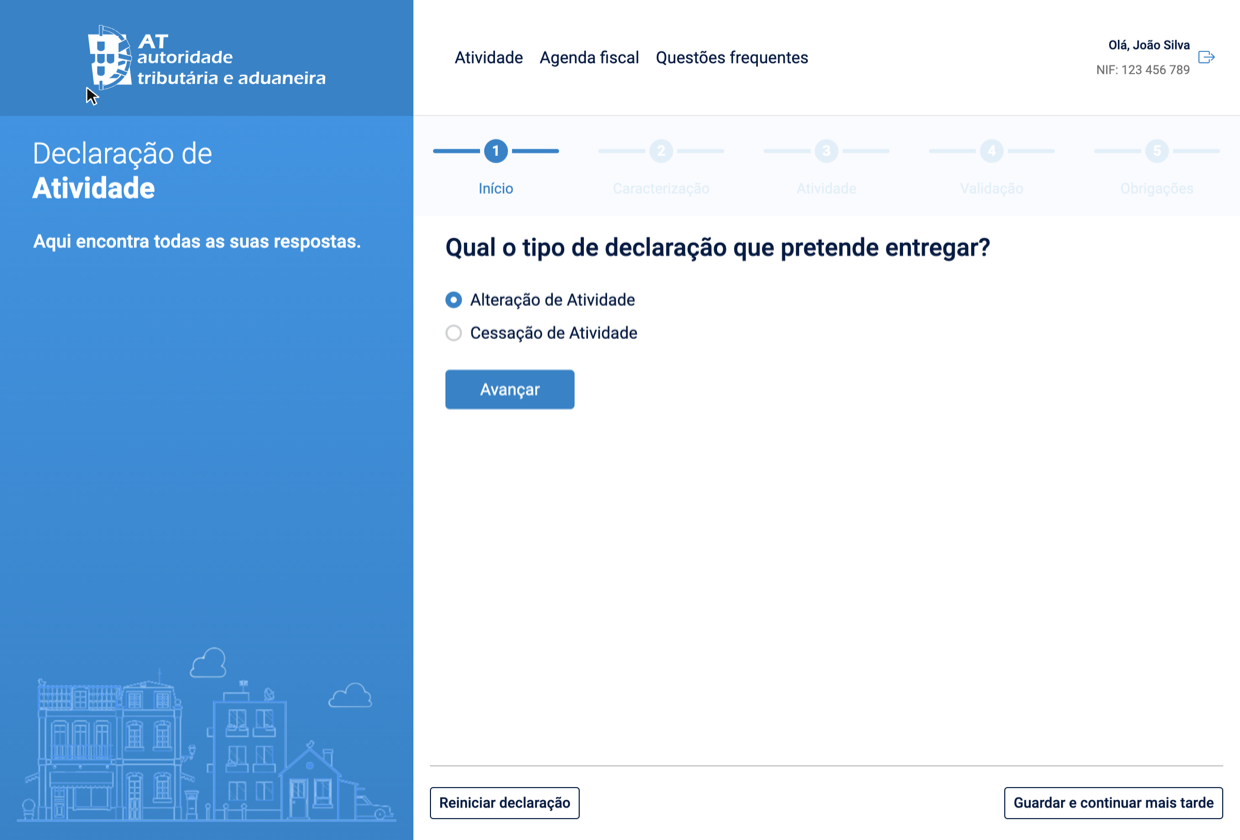
To change your CAE at any time, on the Finance Portal:
- Serviços → Atividade → Alterar Atividade
- Enter the new code
- Submit
- Done — takes 5 minutes
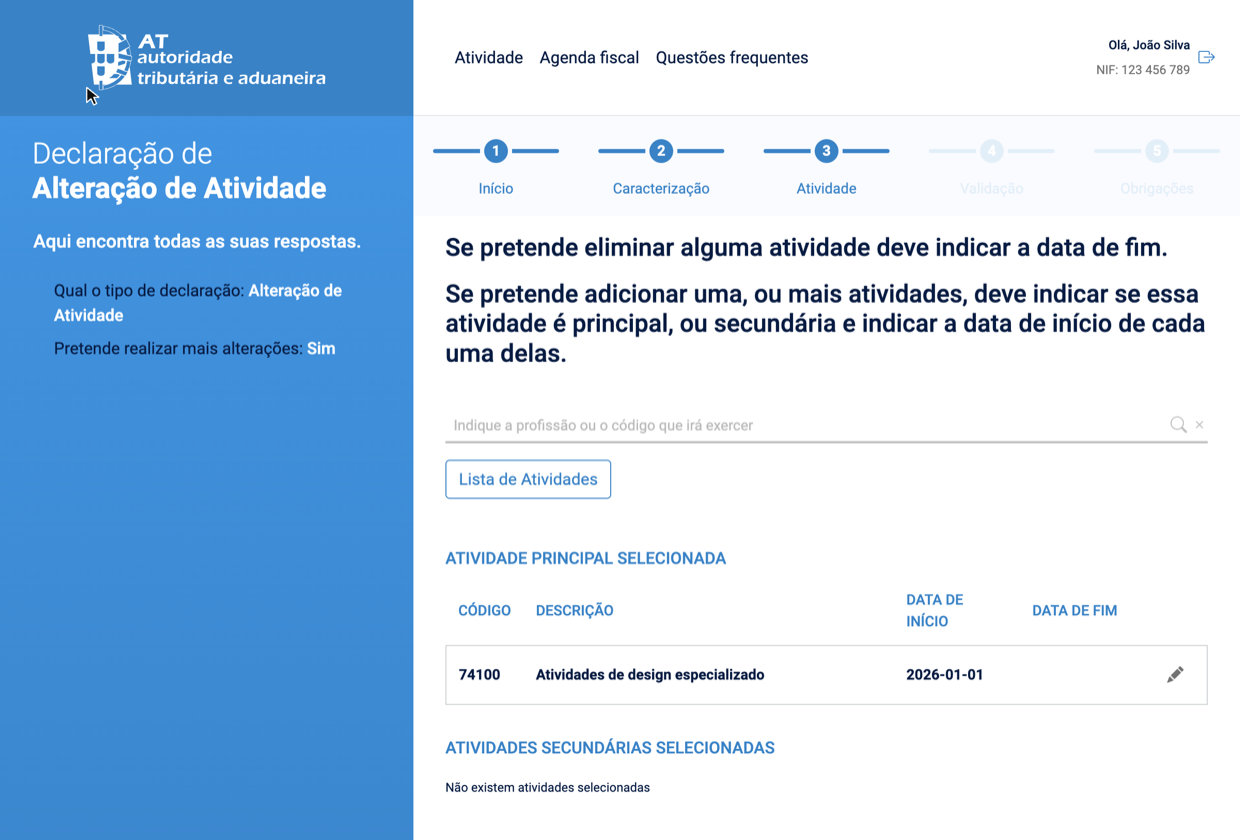
Start by choosing “Alteração de Atividade” (Change of Activity) and moving on:
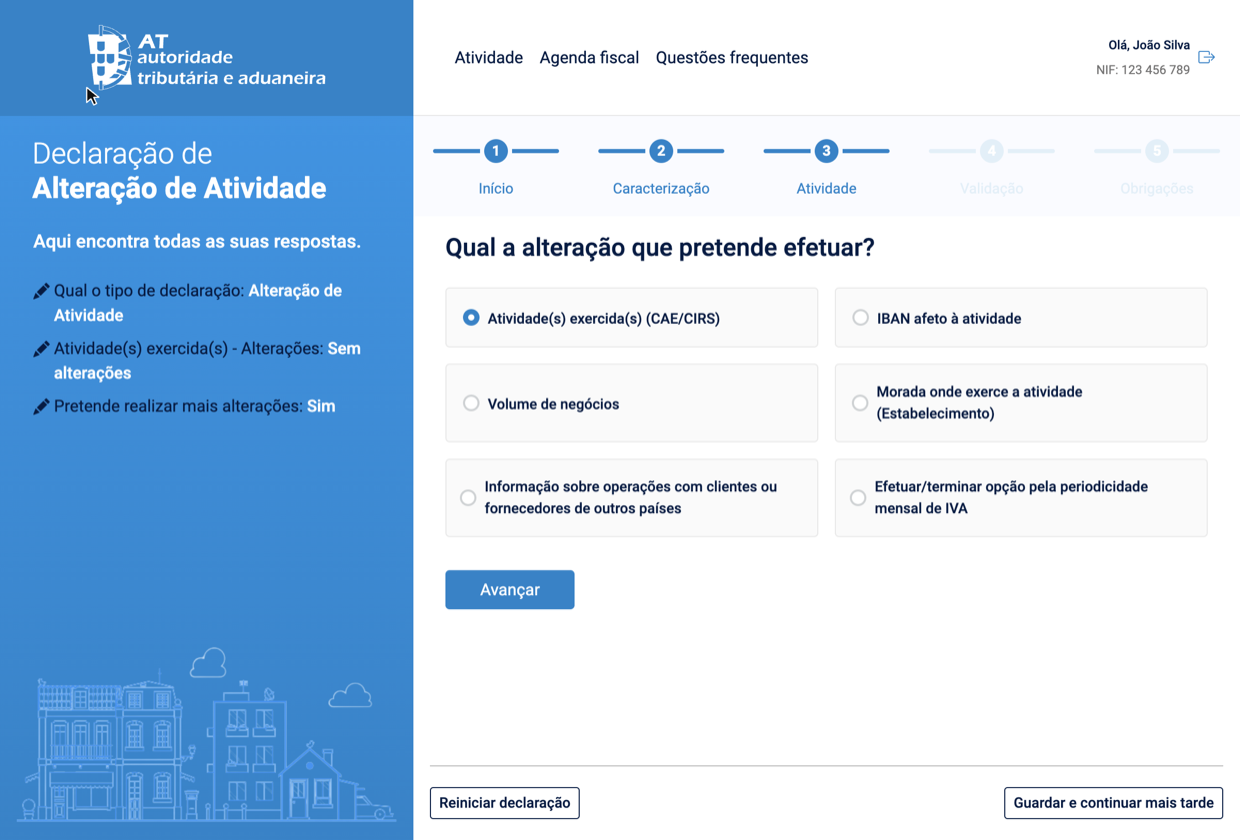
After the information screens, choose “Atividade(s) exercida(s) (CAE/CIRS)” (Activities carried out):
Then enter the new code in the search field — you can type the profession or the code directly:
What the CAE affects (and what it does not)
It affects:
- How you are classified for statistical purposes
- The category that appears on your clients’ e-fatura records
It does not affect:
- VAT exemption (which depends on invoicing volume - except services exempt by nature, such as health and nursing, or recognised teaching and tutoring of school subjects, art. 9.º CIVA - not the CAE)
- Your IRS coefficient (0.75 for Article 151 CIRS professions; 0.35 for other services — it depends on the activity, not the CAE)
- Your Social Security obligations (except professions with their own fund - members of the Ordem dos Advogados or of the Ordem dos Solicitadores e dos Agentes de Execução contribute to CPAS)
✅ In summary
-
CAE is a five-digit code that classifies your activity — choose the one that best describes what you do. The table above covers 90% of common cases.
-
The Article 151 CIRS code is your profession — designers (1336), lawyers (6010), programmers (1332), and so on. On the table → 0.75 coefficient. Not on it → 0.35. It is different from the CAE.
-
With FIZ the CAE is registered once and you never think about it again — invoices, quarterly declarations, and communications to the tax authority happen automatically, whatever your activity code.