
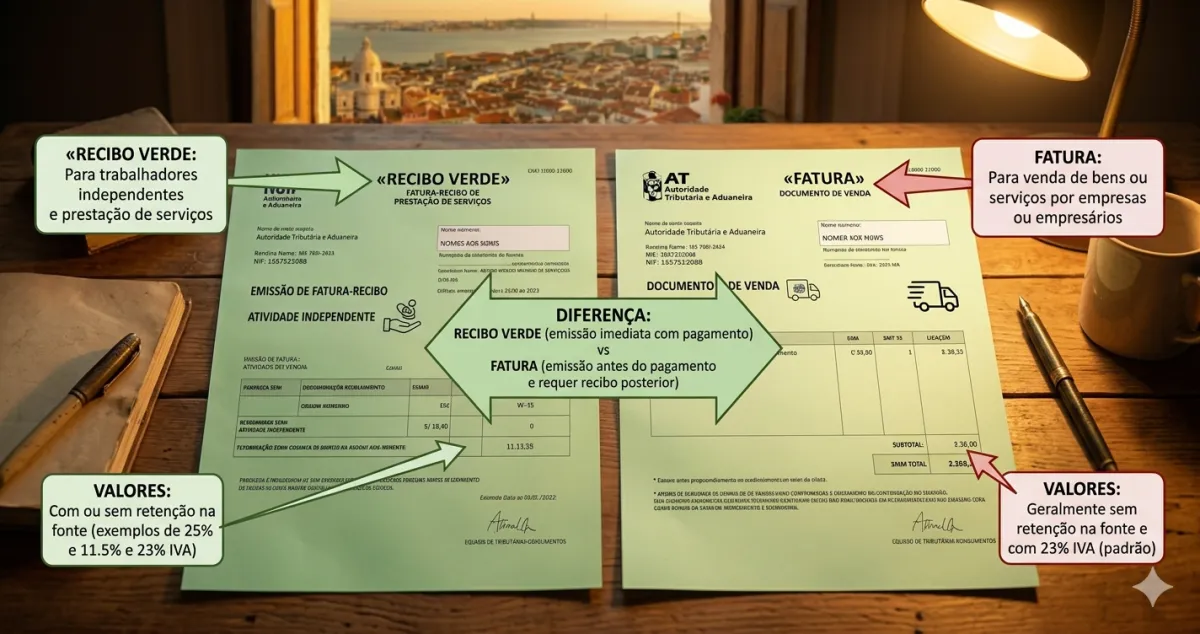
“Did you send an invoice?” — “Yes, I sent a recibo verde.”
This conversation happens every day in Portugal. And usually there’s no problem. But legally, a recibo verde and a fatura aren’t quite the same thing — and understanding the difference can avoid complications.
The history of the recibo verde
The recibo verde isn’t called “verde” (green) by accident. In the 1980s, when the system was created for independent workers, it was literally a green paper form you bought in packs from stationers. You filled it in by hand, tore it out, and gave it to the client.
Today everything is electronic — through the Portal das Finanças or certified software. But the name stuck. And more importantly: the recibo verde remains the primary document for independent workers to evidence service provision.
The practical differences
Recibo verde (fatura-recibo):
- For service provision — what 90% of independent workers do
- Issued after you receive payment
- Confirms you received the money
- May include retenção na fonte (withholding tax, if applicable)
- The official document for independent workers
Fatura:
- For product sales or services with deferred payment
- Issued before or at the time of payment
- It’s a payment request, not a confirmation
- Can have payment terms (30 days, 60 days)
- More formal and business-oriented
Practical example
Sofia does graphic design. A client asks for a logo for €800.
With recibo verde:
- Sofia does the work
- Client transfers €800 via MB Way
- Sofia issues the recibo verde the same day
- Selects “Service provision”, 0% VAT if exempt
- Sends PDF via WhatsApp
With fatura:
- Sofia finishes the work
- Issues a fatura with 30-day payment terms
- Client pays whenever they want (within 30 days)
- Sofia can then issue a receipt of payment
See the difference? With a recibo verde, you receive payment first. With a fatura, you may receive it later.
A note for Social Security: the income’s quarter is the service’s, not the payment’s — the quarterly declaration follows the IRS rules, which attribute income to the service date. A service provided in December belongs in the October to December quarter, even if the client only pays in January. See the full example in the guide to the -25% option in the quarterly declaration.
The most common mistake
Many independent workers issue a fatura when they should issue a recibo verde — because they think “fatura” sounds more professional.
But note: if you’re an independent worker providing services and the client has already paid you, the correct document is the recibo verde. It’s not a matter of preference — it’s what the Tax Authority (AT) expects.
When you actually need a fatura
There are situations where a fatura makes sense:
Physical product sales. Miguel sells personalised t-shirts. He issues a fatura when the client orders, before shipping.
Large companies as clients. Some companies have internal policies requiring invoices with 30- or 60-day payment terms.
Long projects with staged payments. Pedro is building a website over 3 months. He issues a fatura per phase, before receiving each portion.
The 95% rule
In 95% of cases, for an independent worker providing services in Portugal, the recibo verde is the right choice.
It’s the document designed for you, optimised for your reality, and exactly what the AT expects to find when reviewing your income.
In doubt? Use a recibo verde.
✅ In summary
-
Recibo verde is for services paid immediately — it confirms you received payment. It’s the document created for independent workers and covers 95% of cases.
-
Fatura is for deferred payments or product sales — you issue it before receiving payment, as a formal payment request.
-
With FIZ you issue a recibo verde in seconds — the system automatically manages the correct document type for each situation.