
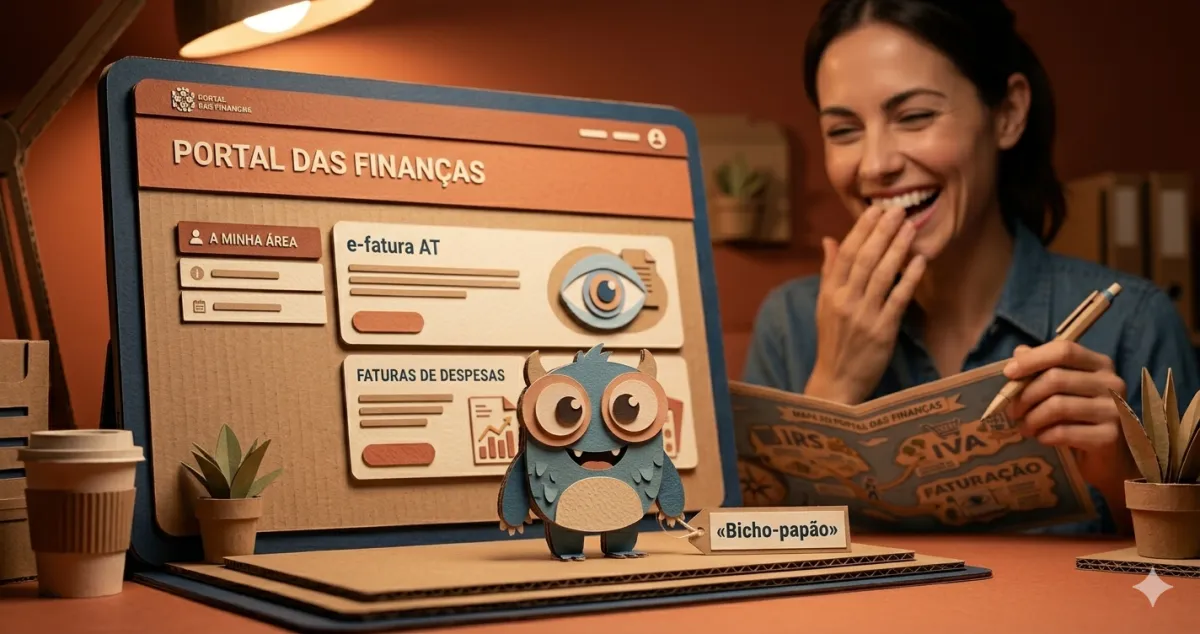
Maria used to spend nights not sleeping before each quarterly declaration deadline. Not from poor organisation. From fear of the Finance Portal (Portal das Finanças) — a website that seemed designed to confuse.
Then she discovered that the Finance Portal is basically online banking. And that the tax authority genuinely wants you to work legally.
The Portuguese tax authority — officially the Tax and Customs Authority (Autoridade Tributária e Aduaneira, often just called Finanças or the tax office) — is the body that runs the Finance Portal, collects IRS and VAT, and handles your tax affairs. Here’s how to deal with it without the dread.
The Finance Portal has 4 buttons
Open the portal and ignore everything in the side menu. As an independent worker, you really only use four areas:
- Consultar (View) — see everything: invoices issued, payments, past declarations
- Entregar (File) — submit declarations (quarterly VAT, annual IRS)
- Pagar (Pay) — pay taxes, just like you pay a utility bill online
- Faturas (Invoices) — issue invoices if you do not use certified software
That is literally it. João, an independent electrician, took 15 minutes to get used to it. “It is like switching banks — at first you cannot find anything, then you do it with your eyes closed.”
The tax authority wants you to work — not to catch you out
Here is what most people do not know: the Autoridade Tributária (AT) needs you to invoice. Every invoice you issue is revenue for the state. They have a direct interest in your professional success.
That is why they provide:
- CAT (telephone support) — you speak with a real person
- e-balcão — submit questions in writing, receive a response within 48 hours
- Simulators — calculate what you will owe before submitting anything
- Practical guides — documentation in plain Portuguese explaining every process
Sofia, a marketing consultant, recalls: “I called the CAT three times in my first month. They always answered, always helped. Once they even told me I was overpaying VAT and showed me how to correct it."
"Simplified” does not mean automatic
The simplified regime (regime simplificado) is a significant relief — but there is one misunderstanding worth clearing up.
“Simplified” refers to how taxable income is calculated: the state automatically applies the 0.75 coefficient (for services), meaning you pay IRS on 75% of what you invoiced. You do not need to keep expense receipts to justify the remaining 25%.
What is NOT automatic: the declarations. You have to file them yourself. Regularly. Without exception.
What you need to file:
- Quarterly VAT return (if not exempt) — deadlines: 20 May, 20 September, 20 November, 20 February
- Quarterly Social Security declaration (from year two onwards)
- Annual IRS declaration — between 1 April and 30 June
How the AT communicates with you
The tax authority sends notifications to the email address you registered on the Portal. Deadline reminders, declaration confirmations, payment notices — everything comes by email.
A simple tip: create a dedicated folder in your email just for Finanças communications. That way you will never miss a deadline by accident.
Three myths that are holding you back
Myth 1: “If I make a mistake, I get an enormous fine immediately” The AT first notifies you and gives you time to correct the issue. Fines arise when deadlines are repeatedly ignored or corrections are refused — not from a first mistake.
Myth 2: “The portal is too complicated for someone without a financial background” Ana, a translator, had never issued an invoice before 2026. “The hardest part was setting up my password on the Portal. After that, everything was intuitive.” With certified software, you do not even need to visit the Portal for day-to-day operations.
Myth 3: “I need an accountant from day one” For most freelancers in the simplified regime invoicing under €15,000, an accountant is not necessary. With the right tools, you manage everything yourself.
✅ In summary
-
The Finance Portal has 4 main sections — View, File, Pay, and Invoices. It feels intimidating on the first visit; it becomes routine quickly.
-
The AT offers real support — phone (CAT), e-balcão with 48-hour responses, simulators and guides. They are a service, not a tribunal.
-
With FIZ quarterly declarations are filed automatically — no need to visit the Portal for recurring obligations.