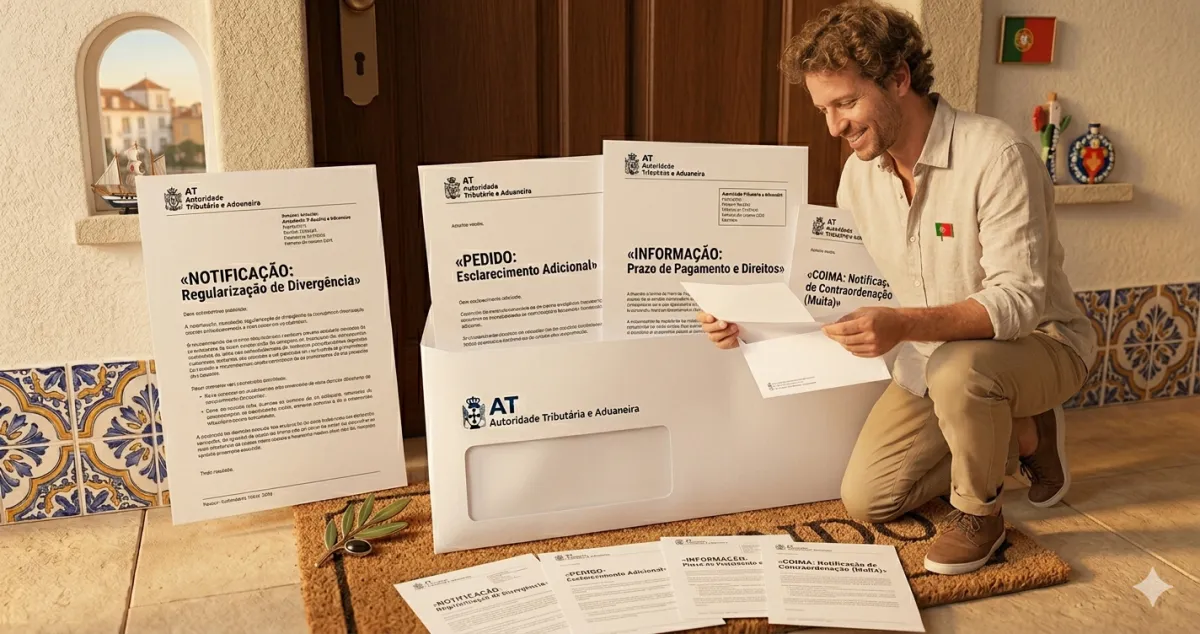
You’re a freelancer and you’ve just received a letter from the Portuguese tax authority (AT)? That white CTT envelope with the AT logo makes your heart race, doesn’t it?
Calm down. Most letters aren’t the monster they seem.
Here are the 4 most common types of letters you might receive and what to do in each case. No drama, no complications.
The 4 most common letter types
1. Informational letter (the easy one)
This is the “friendly” letter. The AT is simply telling you something:
- A change to your tax situation
- Confirmation that a declaration was received
- Changes in legislation that affect you
What to do: read carefully and file it. Usually no response required.
2. Document request (the annoying one)
The AT wants proof of something you declared. A typical example:
Sofia, a graphic designer, declared €3,000 of expenses for IT equipment. She receives a letter asking for invoices.
What to do, step by step:
- Log in to the Portal das Finanças
- Go to “A Minha Área” → “Divergências e-balcão”
- See exactly which documents they want
- Scan everything (PDF or JPG, maximum 5MB each)
- Submit via e-balcão within the deadline (usually 8–15 days — check the letter)
Important: don’t ignore the deadline! If you don’t respond, the AT may reject those expenses and you’ll pay more IRS.
3. Divergence notification (the stressful one)
The AT has detected something wrong in your declarations. Common examples:
- You invoiced more than you declared
- A client deducted VAT from your invoices but you didn’t declare it
- You forgot to submit a quarterly declaration
Miguel, a photographer, invoiced €2,500 to a company in December but only issued the invoice in January. The company deducted in December, he declared in January. Divergence!
What to do:
- Check whether the error actually exists
- If yes: correct it by submitting a substitute declaration
- If no: contest it via e-balcão with evidence
- Typical deadline: 15 days to respond (check your letter — it may be extended)
4. Payment demand (the dreaded one)
The AT says you owe X euros and wants payment. This could be: missing IRS, late filing fines, unpaid VAT, or interest.
What to do immediately:
- Check whether the amount is correct
- If you agree: pay within the deadline to avoid more interest
- If you disagree: you have the right to a gracious appeal (reclamação graciosa) — check the letter for the exact deadline
How to respond without making mistakes
Step 1: identify the letter type
The subject appears right at the top. Look for key words:
- “Para conhecimento” = informational
- “Solicita-se” = document request
- “Notificação” = divergence
- “Liquidação” = payment demand
Step 2: check the deadlines
Every important letter has a deadline. Put it in your calendar straight away. AT deadlines are non-negotiable — no excuses.
Step 3: use the e-balcão
Almost everything can be sorted online:
- Portal das Finanças → Serviços → e-balcão
- “Nova questão”
- Choose the appropriate type
- Attach documents
- Submit
You’ll receive a response within 10-20 working days in the same place.
Mistakes you cannot afford to make
Ignoring the letter — Ana, a translator, ignored a request for clarification. Result? The AT rejected €2,000 of her expenses. She paid an extra €600 in IRS.
Responding after the deadline — deadlines are sacred. Past the deadline = you automatically lose your case, even if you’re right.
Not keeping proof — always save the e-balcão submission receipt. It’s your proof that you responded.
In Summary
- Identify the letter type — informational (file it), document request (respond via e-balcão), divergence (correct or contest), payment (pay or appeal)
- Always respect the deadlines — put them in your calendar as soon as you receive the letter. Past the deadline = you automatically lose
- Prevent the problem at source — with FIZ declarations are automatic and the Escudo Fiscal protects you from fines. The difference between living in fear of the AT and sleeping soundly
Getting a letter from the tax authority doesn’t have to be a drama. With organisation, you can sort everything out calmly.