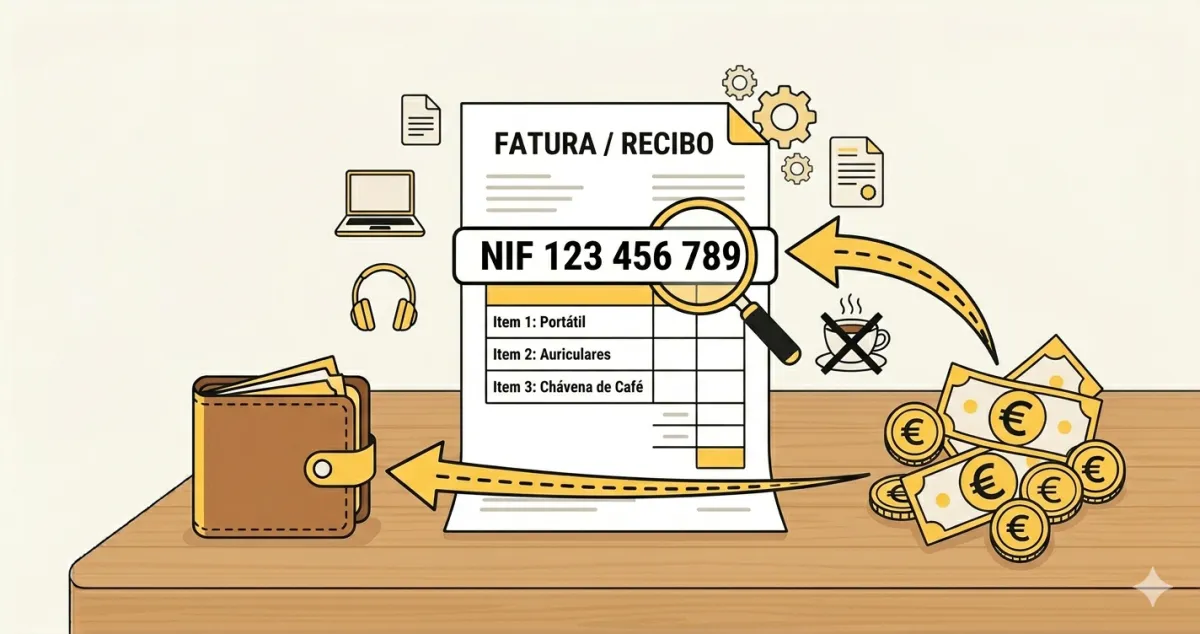

There’s a way of thinking about accounting that makes it immediately frightening: seeing taxes as something the state imposes on you to control, monitor, and eventually punish you.
With this perspective, every declaration is a confession. Every invoice issued is evidence left against you. The Portal das Finanças is a digital interrogation room.
It’s an understandable perspective. And it’s almost completely wrong.
What accounting actually records
When you issue an invoice, you’re not telling the state “this happened”. You’re documenting that you provided a service, received payment, and that your business is functioning.
When you declare your income quarterly, you’re not submitting to an audit. You’re calculating your tax position — how much you owe, how much you’ve already paid, what’s coming.
When you keep your professional expense invoices, you’re not accumulating bureaucracy. You’re building a record that can later reduce your IRS bill.
In each case, the information benefits you as much as — or more than — it benefits the state.
The control panel you never had
An employee knows exactly how much they earn per month. The salary is in the contract. IRS and SS are deducted automatically. At the end of the month, they receive what they receive.
A freelancer has something more interesting: the ability to see the whole system.
If you know how much you’ve invoiced, how much you’ve spent, how much you owe in VAT and SS, how much will be left for IRS at year end — you know exactly where your business stands. At any moment.
That’s not bureaucracy. That’s management information.
The difference between feeling and knowing
When you don’t do accounting (even the simple kind the simplified regime requires), you make decisions based on feelings: “I think I’m earning well”, “it seems like I have enough money”.
When you do, you know: “I invoiced €3,200 this month, I have €640 in VAT to pay this quarter, my estimated net income is X”.
The difference between these two positions isn’t administrative. It’s the difference between driving with your eyes closed and driving with the instrument panel in view.
Note: Most freelancers who “hate accounting” don’t hate numbers — they hate uncertainty. Not knowing when the next declaration is due, not knowing how much tax they’ll pay, not knowing whether they’re compliant. Accounting isn’t the cause of the uncertainty. It’s the remedy.
The state also wants you to be organised
There’s an irony here: the simplified regime was designed by the state to make independent workers’ obligations manageable. It wasn’t designed as a trap.
The 0.75 coefficient that simplifies IRS calculation, the VAT exemption for those invoicing under €15,000, the standardised quarterly return forms — these are all instruments that make the system simpler for you, not more complicated.
The state wants you to comply. That’s why it made compliance easier.
Changing the perspective changes everything
When you stop seeing accounting as surveillance and start seeing it as management information, your relationship with it changes completely.
Quarterly returns stop being a test you might fail. They’re a status update on your business.
The Portal das Finanças stops being a court. It’s a reference tool.
The invoices you keep stop being evidence. They’re documents that belong to you.
This shift doesn’t happen overnight. But it happens — for everyone who decides to face the system rather than avoid it.
✅ In summary
-
Accounting isn’t the state controlling you. It’s you having information about your own business — income, expenses, tax position, projections.
-
The simplified regime was designed to be manageable. The obligations exist, but they’re straightforward. The system wants you to comply, so it made compliance simpler.
-
With FIZ you have your business control panel always up to date — invoicing, taxes, declarations, all in one view.