
For a long time, accounting felt like an emotional tax to me. I knew I had to do it. I did it reluctantly. I finished feeling like I’d given something to the state — time, attention, energy — and received nothing in return.
The shift happened when I realised I was looking at the process backwards.
The professional expense I almost missed
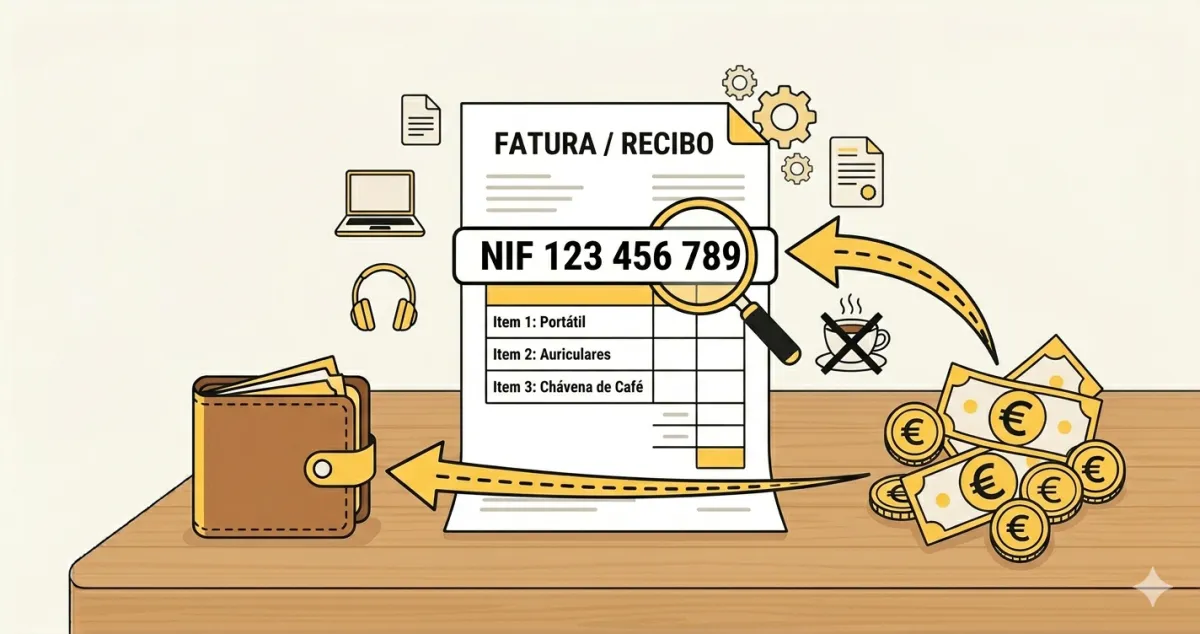
One day, doing my annual IRS declaration, I was listing my professional expenses. Laptop, design software, subscriptions, travel to client meetings.
It came to €1,840 in expenses I could deduct.
I calculated the impact on my IRS bill: in my tax bracket, each euro of deductible expense saved me around €0.35 in tax. 1,840 × 0.35 = €644.
I had just “found” €644 — simply by keeping my invoices and spending 20 minutes listing them.
That was the moment everything changed.
What accounting actually does for the freelancer
Accounting isn’t neutral. It works in your favour when you do it well, and against you when you ignore it.
When you keep professional expense invoices, you’re reducing your IRS bill. When you issue invoices on time, you’re building an income history that will one day be necessary for a mortgage, visa, or contract. When you pay SS on time, you’re accumulating contributory years towards your pension.
Every tax task has a concrete benefit for you — not just for the state.
The problem is that the benefit is invisible when you don’t know what you’re doing. It looks like bureaucracy. It looks like obligation. It looks like cost.
The cost of not doing it
Let’s look at the other side: what happens when you ignore it.
Unrecorded professional expenses = extra tax you pay unnecessarily.
SS in arrears = late payment interest growing month by month, plus loss of access to benefits (sickness, parental leave).
Missing declarations = fines ranging from €150 to €3,750 per missing declaration — money that leaves your pocket with no benefit to you.
Tax ignorance isn’t free. It has a price paid in real money.
Accounting as an ally
This was the perspective that changed everything for me: accounting isn’t a cost — it’s an investment.
The time you invest organising expenses returns money to you via IRS deductions. The time you invest submitting declarations on time saves you fines. The time you invest understanding the system gives you information to make better decisions.
It’s an activity with a positive return — unlike most administrative tasks.
The question that changed my perspective: Instead of “do I really have to do this?”, I started asking “what do I lose if I don’t do this?”. The answer, almost always, was concrete money.
The fear didn’t disappear through knowledge
The fear didn’t disappear when I learnt more about accounting. It disappeared when I started seeing concrete results: less tax, less stress, more clarity about the state of my business.
Knowledge helped. But what really helped was starting to act — and seeing that action produced tangible benefits.
Every time I submitted a declaration and saw “Successfully submitted”, I was confirming the system was under control. Every time I found a deductible expense, I was recovering money I’d otherwise lose.
Accounting stopped being about the state. It became about me.
✅ In summary
-
Accounting has direct financial returns. Deductible expenses reduce IRS. On-time declarations avoid fines. SS paid on time accumulates pension contributions.
-
Tax ignorance has a cost. It’s not a neutral position — it’s a position that costs you money in ways you don’t immediately see.
-
With FIZ you always have a clear view of your numbers — what you’ve invoiced, what you owe, what you save. The dashboard that turns accounting into an ally.