
Remember that feeling of freedom when you opened your activity? Me too. Then the first quarterly declaration arrived and you thought: “What on earth is this?!”
I’ve worked with freelancers for years and I see the same mistakes every time. It’s not your fault — nobody teaches you this stuff. Let’s go through them.
1. Not issuing an invoice when you get paid
Sofia received €1,500 from a client in March. “I’ll issue the receipt when I have time,” she thought. June arrived and she still hadn’t. Result? The invoice was legally due within 5 working days of the service — months overdue is an infraction that can bring a fine, and the March income still counts in March, with or without the document.
How to avoid it: issue the document right away. If the client pays on the spot, a fatura-recibo the same day. If they pay later, a fatura within 5 working days of the service — and the recibo when the money arrives. There’s no “tomorrow” for this.
2. Confusing gross and net
João agreed on €2,000 for a project. He thought he’d pocket €2,000 clean. He forgot that in the simplified regime, 75% of that (€1,500) counts as taxable income. Plus Social Security on top.
How to avoid it: when negotiating, always remember — what you invoice is not what you take home.
3. Not setting money aside for taxes
Ana invoiced €15,000 in her first six months. She spent it all. July arrived and she had to pay IRS instalments. She didn’t have the money.
Important: IRS instalments are paid in July, September, and December. If you don’t set the money aside, you’ll have a problem.
How to avoid it: always set aside at least 25% of everything you invoice in a separate account.
4. Not keeping expense invoices
Pedro bought a new laptop. He threw away the invoice. At the end of the year, he couldn’t deduct the expense from his IRS.
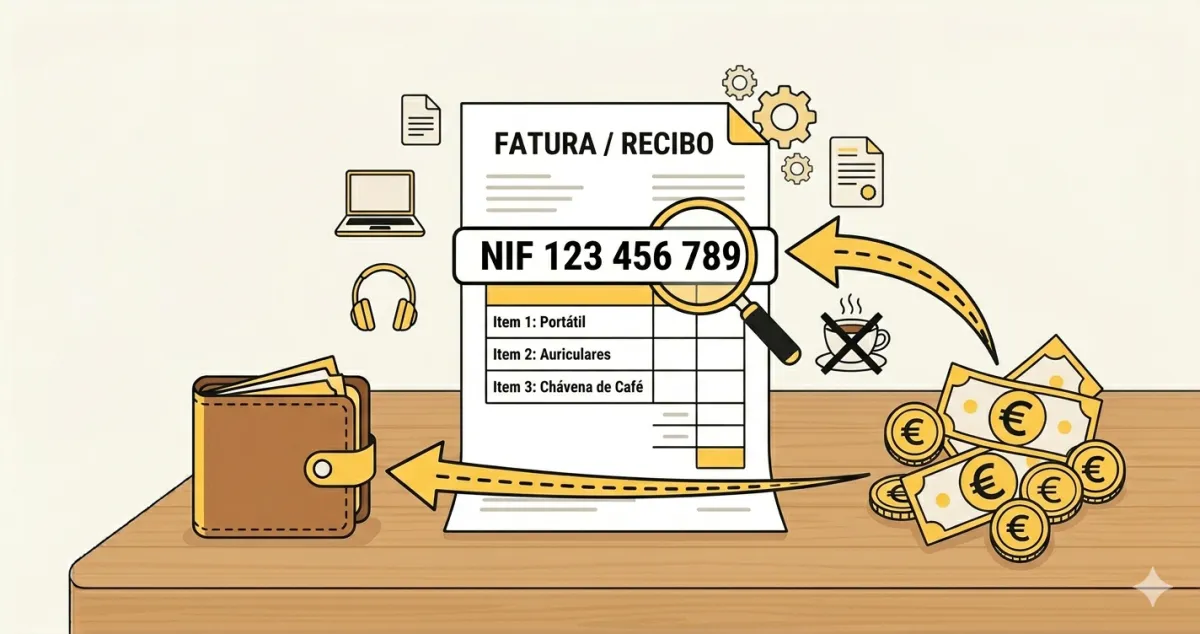
How to avoid it: keep ALL invoices with your NIF. Take a photo and store them somewhere organised — sorted by category.
5. Not updating your income with Social Security
Marta started invoicing €500/month. Then she moved up to €2,000/month but didn’t update her declaration. Result? She underpaid contributions and had to regularise everything later.
How to avoid it: whenever your income changes significantly, update your quarterly Social Security declaration.
6. Not checking e-Fatura
Rui never logged into e-Fatura. One day he discovered he had €300 in invoices waiting to be validated from the past 2 years. He lost all those deductions.
How to avoid it: log into e-Fatura every month. It takes 5 minutes to validate everything. Set a reminder for the 15th of each month.
7. Opening activity in the wrong category
Catarina is a designer but registered as a “consultant”. Result? Wrong VAT code, problems with invoices, endless headaches.
How to avoid it: when you register at the Portal das Finanças, choose the correct CAE code for your actual activity. If in doubt, look it up or ask for help.
8. Not understanding when you’re VAT-exempt
Tiago invoiced €12,000 in his first year and charged VAT to every client. He didn’t know he was exempt (the threshold is €15,000/year).
How to avoid it: if you invoice less than €15,000/year, you’re VAT-exempt under Article 53 of the CIVA. On invoices, select 0% VAT and choose the correct exemption reason.
9. Forgetting declaration deadlines
Inês, in the standard VAT regime, forgot to submit her quarterly return. Automatic fine. “But I didn’t invoice anything that quarter!”, she said. It doesn’t matter — in the standard regime you file anyway, even at zero. (Those exempt under art. 53.º don’t have the regular declaration — they only file for months in which they self-assess VAT on foreign purchases.)
How to avoid it: put these in your calendar:
- Quarterly VAT return (standard regime): by the 20th of the 2nd month after the quarter (Q2: by 20 September)
- Quarterly Social Security declaration: during the month following the quarter (January, April, July or October)
- Annual IRS declaration: between 1 April and 30 June
10. Thinking the simplified regime means everything is automatic
Bruno thought “simplified regime” meant the government did everything for him. It doesn’t. You still have to submit all the declarations yourself.
How to avoid it: simplified only means the tax calculation is simpler (the 0.75 coefficient). Your filing obligations are the same as any self-employed worker.
In Summary
- Issue the document straight away — fatura-recibo when paid on the spot, otherwise fatura within 5 working days — and set aside 25% for taxes — the two most important habits in your first year. Everything else is easier to fix
- Know your deadlines — VAT and Social Security every quarter, IRS between April and June. One missed date = automatic fine
- Automate what you can — with FIZ quarterly declarations are submitted automatically and invoicing takes 4 fields. Fewer mistakes, more time to work
Don’t make the same mistakes we all made. Start on the right foot.